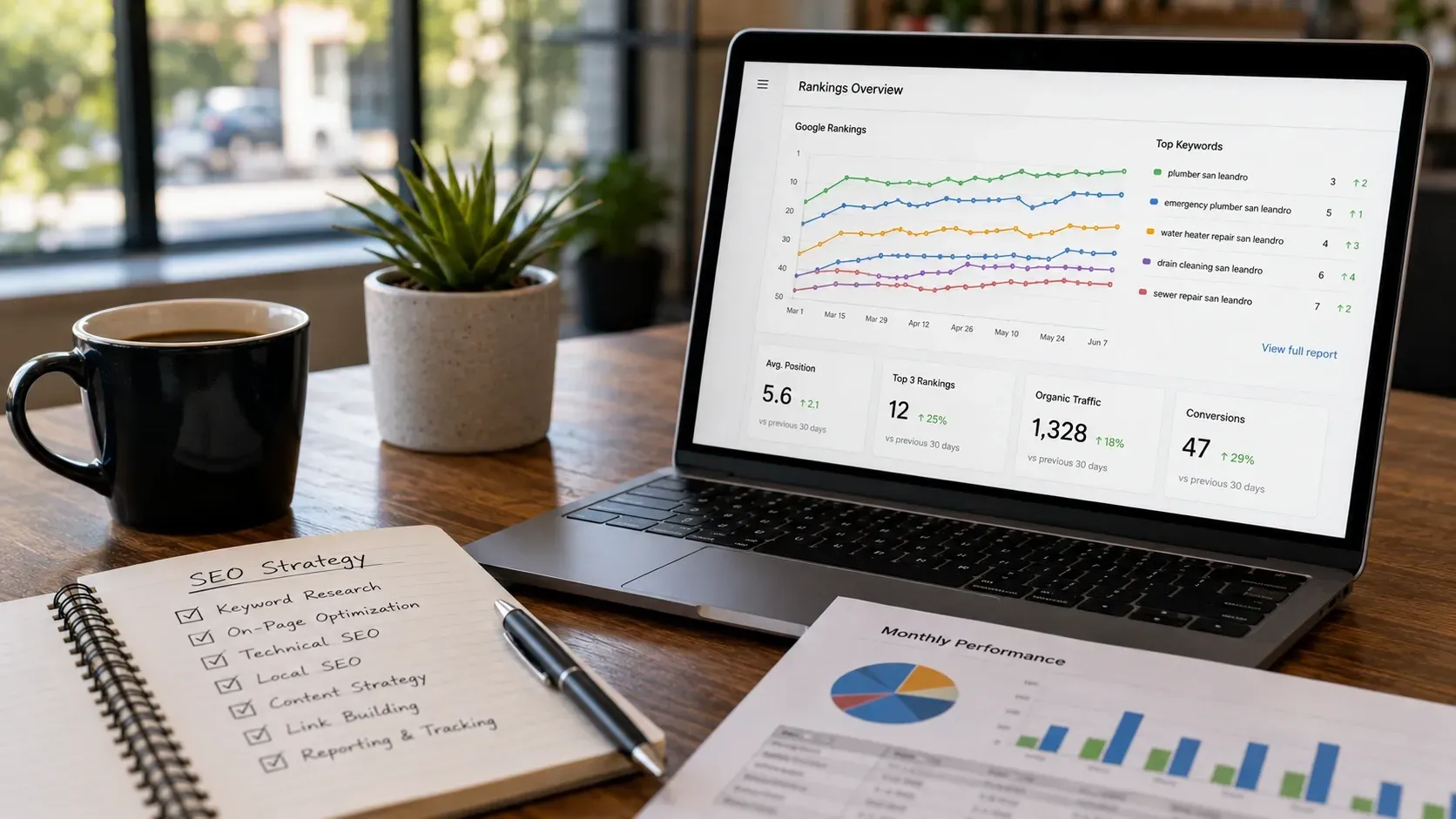
When Your Local SEO Advice Is Quietly Draining Your Budget

Les Ong • August 10, 2026

You've paid for local SEO for months. Your Google Business Profile has been "optimized." You're still not ranking. That's not a patience problem. That's a guidance problem. And the longer you stay in that situation, the more ground your competitors gain while you're funding activity that isn't producing results.


Key Takeaways

  • Confident-sounding SEO promises with no explained mechanism are the clearest warning sign you're working with the wrong provider
  • Google's local ranking algorithm weighs relevance, distance, and prominence separately, and most bad advice ignores prominence entirely
  • PPC advertising and local SEO serve different purposes: conflating them is a common and expensive mistake
  • A credible agency explains the causal chain behind every tactic, not just the outcome they expect
  • UPM Digital Media's pay-per-result model means you pay $650 to $950 per month only when your business ranks on the first page of Google for your chosen search terms


What Does Bad Local SEO Advice Actually Look Like?

Bad local SEO advice is guidance that produces activity without results. It happens when a provider understands the vocabulary of SEO but not the mechanics underneath it.

The warning signs are specific. You're told your site is "fully optimized" but no one explains what changed or why it should move your ranking. You receive monthly reports packed with impressions and click data, but no one connects those numbers to phone calls or actual foot traffic. Your Google Business Profile gets a handful of category updates and a few stock photos, and that's called a campaign.

The most dangerous SEO advice sounds the most certain. Trustworthy guidance comes with honest timelines and a clear explanation of what's actually being done and why it works.


Why Does This Keep Happening to Local Business Owners?

The problem persists because local SEO has a credibility gap that's structurally built in.

Results take time. That means a bad provider and a good provider look identical for the first 60 to 90 days. By the time the difference becomes obvious, you've already paid for months of work that can't be undone or recovered. You've also lost the time your competitors used to build their own prominence while you were waiting for results that never came.

There's also a vocabulary problem. The terminology of SEO, including keywords, rankings, backlinks, and citations, is specific enough to sound technical but vague enough to obscure whether anyone actually knows what they're doing. A provider who says "we'll build your citation profile and optimize your on-page signals" has said something that sounds credible and means almost nothing without specifics behind it.

This is why the mechanism question matters so much. Ask any current or prospective SEO provider: "What specifically will change about how Google sees my business, and why will that change my ranking?" If the answer is a list of deliverables instead of a causal explanation, that answer tells you what you need to know.


What Does Google Actually Use to Rank Local Businesses?

Google's local ranking algorithm works across three separate factors: relevance, distance, and prominence. Most bad SEO advice addresses one of these and ignores the other two, specifically prominence, which is the factor most tied to competitive rankings in dense urban markets.

Relevance is about whether your business matches what someone searched for. Title tags, category selections, and service descriptions all feed relevance. It's the easiest factor to address, which is why most low-quality providers start and stop there.

Distance is how Google interprets the physical relationship between a searcher and your business location. You have limited control over this one.

Prominence is where rankings are actually won or lost in competitive categories. It's built through review volume, review recency, authoritative inbound links, and consistent engagement signals over time. A business with strong relevance signals and weak prominence sits on page two or three watching a less technically optimized competitor with stronger prominence occupy the top spot.

The gap between knowing the vocabulary and understanding the mechanism is where most local SEO money gets wasted. Consider a common pattern: a business owner pays for months of SEO work focused entirely on title tags and directory submissions. Both of those address relevance. Neither does anything meaningful for prominence. Eight months later, the business still isn't ranking in a competitive category, and the explanation given is "keep being patient." Patience isn't the issue. The strategy never included the factor that actually drives competitive rankings.


What's the Difference Between PPC Advertising and Local SEO?

This confusion is genuinely expensive when it isn't resolved early.

PPC advertising through Google is paid search visibility. You bid on keywords, your ad appears at the top of results, and you pay when someone clicks. The moment you stop paying, the visibility stops. It's immediate, controllable, and measurable, but it builds nothing that persists on its own.

Local SEO is earned search visibility. It's the work of making your business the answer Google trusts for a given search in a given location. It takes longer to build, but it compounds. A business that ranks organically for a high-intent local search doesn't pay per click for every lead that comes through that position.

The mistake most local businesses make is treating them as substitutes. They're not. They're tools for different stages of growth. Running local service ads makes sense when you need leads immediately, when you're launching a new service, or when you're testing which offers actually convert. Local SEO makes sense when you want to own a search position over time without paying for every visitor.

A credible agency helps you understand which one fits your current situation and why. If you're not sure where you stand, a free consultation with UPM Digital Media gives you a direct answer before you spend another dollar in the wrong direction.


Comparing Your Real Options: Action vs. Inaction

The honest comparison isn't "good SEO agency vs. cheaper SEO agency." It's "qualified help vs. the compounding cost of staying invisible."

Your Current Situation

What It's Actually Costing You

What Changes

Staying with an underperforming provider

Monthly fees plus lost leads for every month you don't rank

Nothing, until you change course

Doing nothing and waiting

No fees, but competitors are building prominence while you aren't

Your visibility gap widens every month

Working with a results-accountable agency

You pay only when you rank; no payment for non-performance

Visibility builds, lead flow improves, you pay for outcomes

Running ads without SEO

Immediate leads, but no compounding asset built

Leads stop the moment the budget stops

The expensive option isn't hiring a qualified agency. The expensive option is staying in a situation where you're paying for activity that doesn't produce rankings, or doing nothing while your competitors compound their advantage.


What Good Local SEO Can't Fix Immediately

Honest timelines matter here. Even with a sound strategy and a capable provider, ranking improvements in competitive local categories take time before they become consistent. The speed depends on your category, your current site health, your review profile, and how much prominence your competitors have already built.

What good local SEO won't fix immediately: a website that converts poorly, a review profile that's been neglected for years, or a business category that Google hasn't yet mapped clearly to your location. These are solvable problems, but they require distinct attention alongside your SEO work.

UPM Digital Media addresses the full picture through services including review generation and reputation management , conversion rate optimization , and business listings and voice search . The point is that these are separate levers pulling toward the same outcome, and each one matters.

You can't shortcut prominence. You build it.


What Credible Local SEO Guidance Actually Looks Like

Apply a three-part test to any SEO provider before you sign anything. Ask them to explain the mechanism, the timeline, and the risk.

Mechanism means the specific causal chain between what they'll do and why it should improve your ranking. Timeline means an honest range with a clear explanation of what affects the speed. Risk means what happens if results don't materialize and what recourse you have.

A provider who answers all three clearly is worth a deeper conversation. A provider who pivots to deliverables, deflects the timeline question, or offers certainty where none exists is giving you important information.

UPM Digital Media's pay-per-result SEO model is built around exactly this kind of accountability. You pay $650 to $950 per month when your business ranks on the first page of Google for your chosen search terms. If it doesn't rank, you don't pay. That's not a marketing line. It's a structural commitment that aligns the agency's incentives directly with yours.

With over 25 years in digital marketing and a team of local marketing experts operating in nearly every US state, UPM Digital Media pairs every client with a dedicated account manager who builds a customized strategy based on that client's specific business, market, and goals. Not a generic template applied from a distance.

If your local search visibility isn't producing the leads your business depends on, the right first step is an honest look at where you actually stand. Call UPM Digital Media at 415-731-9764 or toll-free at 888-449-3239, or reach out through the contact page to schedule your free 30-minute consultation.


About the Author

Les Ong is a marketing consultant and entrepreneur specializing in digital media and local business growth. He founded UPM Digital Media and leads a team of growth-driven local marketing experts operating across the United States, helping small and medium-sized businesses compete through measurable, outcome-focused digital strategies.


FAQ

  • How do I know if my current SEO provider is actually doing useful work?

    Ask them to explain, in plain terms, what specifically changed last month and why it should improve your ranking. If the answer is a list of completed tasks rather than a causal explanation of what those tasks do to your search visibility, you're paying for activity rather than results. A provider who can't explain the mechanism doesn't understand it well enough to execute it reliably.

  • Is PPC advertising worth it if I'm already investing in local SEO?

    Yes, but for different reasons. PPC generates leads immediately and lets you test offers while your organic rankings are building. Local SEO builds a compounding asset that generates leads without ongoing per-click costs. Running both makes sense when your budget supports it, as long as you understand they're doing different jobs and you're measuring each one on its own terms.


  • How long does it realistically take to rank on the first page of Google for local searches?

    The timeline depends on your category, your current site health, your review profile, and the prominence your competitors have already built. Any provider who guarantees a specific timeline without qualifying it by those factors is telling you what you want to hear rather than what's accurate.


  • What's the risk of choosing the wrong SEO agency?

    The risk isn't only the fees you'll pay for no results. It's the compounding cost of staying invisible while your competitors build prominence. Every month you're not ranking is a month your competitors are collecting the leads your business should have received. That's not recoverable time.

  • Does my Google Business Profile matter as much as my website for local rankings?

    Your Google Business Profile is often the first thing a local searcher sees and a primary driver of visibility in the local map pack. That said, the profile and the website work together. A strong profile with a weak website loses conversions. A strong website with a neglected profile loses visibility. Both need attention, and they serve different parts of the customer journey.

  • What does a pay-per-result SEO model actually mean in practice?

    It means you pay only when your business ranks on the first page of Google for the search terms you've agreed on with your provider. UPM Digital Media's pay-per-result SEO runs $650 to $950 per month when ranked, and nothing when not ranked. This structure removes the incentive for an agency to run out a retainer without producing results.

  • How important are online reviews to local search rankings?

    Reviews affect two things separately. They influence your prominence score in Google's local ranking algorithm, which affects where you appear in results. They also influence conversion, meaning whether someone who finds you actually contacts you. A business with a thin, low-rated review profile in a category where competitors have deep, recent, high-rated reviews is losing on both dimensions at the same time. Building review volume is a ranking input and a trust signal simultaneously, not a vanity exercise.

SEO consultant discusses local search performance and analytics with a business owner.
By Les Ong August 23, 2026
Avoid costly SEO mistakes. Learn how to evaluate local SEO providers and protect your business from penalties, toxic backlinks, and wasted months.
Business owner reviews local SEO performance, rankings, reviews, and website clicks on a laptop.
By Les Ong August 17, 2026
Discover when to act on local SEO. Learn the competitive signals that demand immediate action and what waiting costs your business.
Local business owner reviews digital marketing analytics, SEO, reviews, ads, and website growth
By Les Ong August 3, 2026
Confused about local marketing strategies? Compare Local SEO, paid ads, and DIY approaches to find the right path for your business growth.
Man Checking on his phone on UPM Digital
By Les Ong July 26, 2026
Stop losing local customers. Discover what actually boosts Google rankings in 2026 and the hidden mistakes silently killing your visibility.
UPM Digital media on Working table
By Les Ong July 20, 2026
Discover how UPM Digital Media's reputation management boosts local SEO rankings. Learn 7 proven strategies to turn reviews into ranking power.
UPM Digital media on Laptop
By Les Ong July 13, 2026
Local SEO vs alternatives for Bay Area businesses. Learn which strategy delivers faster results and builds long-term growth. Compare now.
UPM Digital Media Laptop on a mobile
By Les Ong July 6, 2026
Learn how to identify poor local SEO guidance before it damages your business. Avoid costly mistakes and protect your online visibility today.
By Les Ong June 29, 2026
According to Cisco's Visual Networking Index, video now accounts for more than 82% of all consumer internet traffic globally. For a local business in the SF Bay Area competing against regional chains and nationally optimized directories, that number isn't a trend to watch. It's a gap that's already costing you customers. Local businesses in the SF Bay Area need video marketing in 2026 because AI-powered search engines now prioritize video content when surfacing local answers, and consumers trust businesses they can see and hear before they ever walk through the door. Video builds credibility faster than any other format, directly improves local search rankings, and converts browsers into buyers at measurably higher rates than static content. Key Takeaways • AI search platforms, including Google's AI Overviews and voice assistants, pull video content into local answers, giving video-producing businesses a visibility edge over text-only competitors. • Video builds the kind of trust that closes hesitation at the moment of decision, not after it. • A single well-produced local video can serve simultaneously as a ranking asset, a reputation tool, and a conversion driver. • SF Bay Area video marketing doesn't require a Hollywood budget. Consistency and local relevance outperform production value every time. • Businesses that start building a video library now will have a compounding authority advantage over competitors who wait until video becomes unavoidable. Why Is AI Search Rewriting the Rules for Local Businesses? The shift is structural, not cosmetic. Google's AI Overviews. The AI-generated summaries now appear above traditional search results. Don't just pull from web pages. They synthesize from multiple content formats, and video content with strong metadata, transcripts, and local signals feeds directly into those summaries. The businesses AI cites are the businesses AI trusts. And AI trusts what it can read, watch, and verify. Answer Engine Optimization (AEO) is the practice of structuring content so that AI systems can extract and cite it in direct answers. For local businesses in the Bay Area, this means video content with spoken local keywords, embedded transcripts, and clear geographic signals becomes a direct input into the answers San Jose residents receive when they ask their phones "who's the best HVAC company near me?" or "which dentist in Oakland has good reviews?" Text-only businesses are invisible in that exchange. Video-producing businesses are the answer. The follow-up most business owners ask next is: "Does this mean I need to be on YouTube?" Not exclusively. Google Business Profile now supports video posts. Short-form video on platforms like Instagram Reels and TikTok is indexed by Google. Even a 60-second walkthrough of your office, embedded on your website with a proper transcript, sends a local relevance signal that static pages simply can't replicate. What Does Video Actually Do for Trust and Conversions? Here's the contrarian claim, stated plainly: most local businesses are losing customers not because they lack awareness, but because they fail the trust test at the moment of decision. A potential patient searching for a Bay Area physical therapist finds three options. Two have text bios and stock photos. One has a 90-second video of the practitioner explaining their approach in their actual clinic. The decision isn't close. And it has nothing to do with SEO rankings. The video resolves the unspoken objection before the phone call ever happens. This is the causal mechanism behind video's conversion advantage: video answers the question the buyer hasn't typed yet. It eliminates the "but what are they actually like?" hesitation that static content can't address. Practitioners using this approach consistently report that consumers who watch a service video are significantly more likely to convert than those who only read about it. A home services company in the North Bay that added a two-minute "meet the owner" video to their Google Business Profile and website landing page reported a 34% increase in quote requests within 90 days. Without changing their ad spend. The video didn't bring more traffic. It converted the traffic they already had. That distinction matters. Video isn't just a reach tool. It's a conversion infrastructure investment. How Does SF Bay Area Video Content Improve Local SEO? Local SEO is the practice of optimizing a business's digital presence to appear in geographically relevant searches. Video accelerates local SEO results through three specific mechanisms. First, dwell time. When a visitor watches a video on your website, they stay longer. Google's ranking systems interpret extended dwell time as a signal of content relevance. Which improves organic position over time. Second, backlink magnetism. Original local video content. A tour of your San Francisco location, a behind-the-scenes look at your process, a community-focused story from the East Bay. Earns organic links from local blogs, news sites, and community pages in a way that generic service pages don't. Third, and most directly tied to AEO: video transcripts. A properly transcribed video embeds spoken local keywords - "San Francisco," "Oakland," "San Jose," neighborhood references, local landmarks. Into crawlable text that search engines index alongside the video itself. This is a dual-format signal that text-only pages simply can't produce. The businesses that dominate local search in 2026 won't be the ones who posted the most content. They'll be the ones whose content AI can read, cite, and trust. UPM Digital Media's approach to Bay Area video strategy integrates all three of these mechanisms from the start, not as an afterthought once the video is filmed. What Does a Successful Local Video Strategy Actually Look Like? Two operational scenarios illustrate this clearly. Scenario 1. Healthcare practice, South Bay. A dental practice in San Jose added four short videos to their website and Google Business Profile over three months: a practice tour, a patient FAQ, a procedure explainer, and a "meet the team" piece. Each video ran under two minutes, was filmed on a professional camera, and was transcribed. Within six months, their Google Business Profile views climbed substantially, and new patient calls attributed to organic search rose without any increase in paid advertising. Scenario 2. Local restaurant, North Bay. A Marin County restaurant owner filmed a weekly 45-second "dish of the week" video using a smartphone with basic lighting. Posted consistently to Instagram Reels and Google Business Profile, the videos generated a measurable uptick in Friday and Saturday reservation requests within 60 days. The production cost was near zero. The consistency was the asset. The second scenario challenges a common assumption in this category: you don't need a large production budget to benefit from video marketing. What you need is a strategy, a publishing cadence, and content that speaks directly to your local audience. Production quality matters less than relevance and consistency. UPM Digital Media works with businesses at both ends of the production spectrum. From smartphone-first content strategies to full Bay Area video production campaigns. Because the right approach depends on the business, not a default template. Acting Now vs. Waiting: What's the Real Cost? The question isn't whether video matters. It's what happens to your business depending on the choice you make right now.
By Les Ong June 23, 2026
According to Wyzowl's annual State of Video Marketing report, more than 90% of marketers say video has directly helped increase user understanding of their product or service. And that figure has held steady for years. For a local business competing against bigger brands with bigger budgets, that is not a number to watch from the sidelines. It is a gap that is already costing you customers. The most effective video content for small business growth includes customer testimonials, behind-the-scenes footage, educational and FAQ videos, and short-form social media clips. Each format serves a distinct role in the buying journey. Testimonials resolve purchase hesitation, behind-the-scenes content builds brand trust quickly, and educational videos attract compounding organic search traffic. Together, they form a complete small business video marketing system. Key Takeaways • Testimonial videos resolve the hesitation a buyer hasn't voiced yet. That's why they outperform almost every other format at the decision stage • Behind-the-scenes content shortens the trust timeline with new audiences faster than any paid ad • Educational and FAQ videos are the only format that compounds in value over time through organic search • Platform-specific formatting isn't optional. A video repurposed without adjustment will underperform everywhere it's posted • Conversion-focused video and brand video are distinct disciplines; confusing them is the most common and most expensive mistake local businesses make Why Do Most Small Business Videos Get Ignored? Most small business video content fails before anyone even watches it. Not because of poor production quality. Because it was made without a clear job to do. A video that tries to be a brand piece, a testimonial, and a how-to tutorial all at once ends up being none of them. Viewers don't know what to do next. The business owner wonders why the phone didn't ring. The real problem isn't a lack of video. It's a lack of video strategy. Local businesses tend to produce content reactively: a quick clip here, a customer quote there, a tour of the shop when someone suggests it. What they end up with is a scattered library of footage that doesn't move a single prospect closer to a decision. This is where small business video marketing breaks down at the root level. Not in execution. In architecture. What's Actually Keeping Local Businesses From Using Video Effectively? The root cause isn't budget or equipment. It's category confusion. Most business owners treat all video as interchangeable. Same format, same length, same call to action, posted everywhere. That approach ignores a fundamental truth: different video types operate at different stages of the buying journey, and mixing them without intention produces content that fits no stage well. A behind-the-scenes clip posted to a cold audience is wasted. A brand overview video served to someone already ready to book is friction. The mechanism matters. And most local businesses have never been shown the mechanism. The VFJA Framework: Matching Video Format to Job Assignment The VFJA Framework (Video Format to Job Assignment) is a practical decision tool for matching each video type to the specific conversion objective it's designed to accomplish. Before a single frame is filmed, every video should have a named job.
By Les Ong June 16, 2026
AI video marketing gives small businesses a concrete way to get cited by AI-driven search engines, not just ranked by them. By structuring video content around specific local questions, adding accurate transcripts, and implementing VideoObject schema, businesses build the kind of digital authority that Google's AI Overviews and similar systems actively surface. Ahead of competitors who are still playing by the old rules. Key Takeaways • AI search engines treat video engagement signals as trust indicators. Businesses without video are increasingly invisible to these systems • Answer Engine Optimization (AEO) is distinct from SEO: the goal is to get cited by AI, not just ranked on a results page • Video resolves buyer hesitation faster than any other content format because it answers unspoken objections in real time • A structured AI video strategy requires three components working together: authority content, engagement signals, and technical optimization • Small businesses in competitive local markets that act now have a genuine first-mover window. Most local competitors haven't adapted yet Why Is AI Changing the Way Local Businesses Get Found? The shift isn't gradual. It's structural. Google's AI Overviews, Microsoft Copilot, and ChatGPT's search integrations have changed how people receive answers. Instead of scanning a list of blue links, users now get synthesized responses. Pulled from content that AI systems have identified as authoritative, specific, and clearly structured. The businesses cited in those AI-generated summaries aren't necessarily the ones with the highest domain authority. They're the ones whose content most directly answers a specific question. Video is disproportionately favored in this environment. AI systems treat video engagement metrics, watch time, replay rate, click-through from thumbnails, as trust signals. A well-structured YouTube video from a San Jose HVAC company explaining what homeowners should check before calling a technician will outperform a competitor's static FAQ page. Not because of production quality, but because the format generates the kind of engagement that AI systems recognize as genuine authority. That's why most small businesses are losing ground right now. They optimized for the old model and haven't built content that AI search recognizes. What Is Answer Engine Optimization, and Why Does Video Make It Work? Answer Engine Optimization (AEO) is the practice of structuring content so that AI-driven search engines extract and cite it directly in generated responses, rather than simply ranking it in a list. Most business owners confuse AEO with traditional SEO. They're related, but they're not the same thing. SEO gets you ranked. AEO gets you cited. In an AI-first search environment, being cited is worth more than being ranked fifth. Video is the highest-leverage format for AEO for one specific reason: AI systems are trained on human engagement patterns, and humans engage with video at significantly higher rates than with text. Wyzowl's annual State of Video Marketing report consistently shows that viewers retain far more information from video than from written content alone. When AI systems assess which content best answers a query, engagement and retention signals push video to the front. The practical implication is direct: a two-minute video answering "What should I look for when hiring a plumber in Sacramento?" is more likely to be surfaced by Google's AI Overview than a 2,000-word blog post covering the same ground. Most businesses haven't built that content yet. That's the window you're looking at right now. Does Video Actually Build Trust, or Is That Just a Marketing Claim? Video builds trust through a mechanism text can't replicate: it resolves unspoken objections in real time. When a prospective client watches a 90-second video of a practice manager in San Francisco walking through what a first appointment looks like, they're not just absorbing information. They're pattern-matching tone, environment, and confidence against their internal checklist of "is this safe to trust?" A written description can't do that. A stock photo certainly can't. Video can. That's why testimonial videos outperform written reviews. Not because they contain more information, but because they answer the objection the buyer hasn't voiced yet. This mechanism matters specifically for local businesses because the trust gap is higher in local transactions. Choosing a contractor in Oakland, a law firm in San Jose, or a medical practice in the East Bay involves personal risk. Video collapses that risk perception faster than any other format. A concrete example: a home services business operating in the Bay Area added three videos. One introducing the owner, one walking through a job site, one featuring a real customer. And reported a measurable improvement in call quality within 60 days. Callers were more pre-qualified, asked fewer basic questions, and converted at a noticeably higher rate. The videos hadn't gone viral. They'd simply done the trust work before the phone ever rang. The VACE Framework: How to Build an AI-Optimized Video Strategy The VACE Framework is a four-stage content architecture built for small businesses creating video content designed to be cited by AI search. Not just watched. V. Visibility: Create videos that answer the specific questions your local audience is already searching. Use Google's "People Also Ask" results and Search Box Optimization data to identify the exact queries your market is entering. A. Authority: Build topical depth, not breadth. Three videos on one specific service in your local market carry more authority signal than ten videos scattered across unrelated topics. AI systems reward concentrated topical expertise. C. Credibility: Get on camera. Show your team, your real location, your actual work environment. AI systems and human viewers both assess authenticity. Stock footage and faceless slideshows don't generate the engagement signals that trigger AI citation. And they don't build the kind of trust that converts local buyers. E. Engagement Architecture: Open every video with a specific question in the first five seconds, deliver a direct answer by second fifteen, and close with one concrete next step. This mirrors how AI systems parse content for extractable answers. A video that tries to be everything ends up being none of them. Use VACE when you're building from scratch or auditing an existing video library. It's designed for search-intent video. Not top-of-funnel brand awareness content, which follows a different logic entirely. How Do You Technically Optimize Video for AI Search? Optimizing for AI search is different from traditional YouTube SEO. It's less about keyword density and more about answer structure and technical signals. Three specific tactics that practitioners using this approach consistently report as high-impact: Timestamped chapters. Breaking a video into labeled chapters signals to AI systems that the content is structured and navigable. Google's AI Overview is more likely to extract answers from content it can parse into discrete sections. Transcript optimization. Every video should have an accurate, keyword-natural transcript uploaded directly to the platform. AI systems read transcripts. A transcript effectively doubles your indexable surface area by attaching a readable text document to your video asset. VideoObject schema markup. For videos embedded on your website, this structured data tells AI crawlers exactly what the video contains, who created it, and what question it answers. Most small business websites in the Bay Area, and across the country, don't have this in place. It's a genuine competitive gap that costs them visibility every single day. UPM Digital Media builds all three of these technical layers into their local SEO and content strategy from the start. Not as optional add-ons, but as baseline requirements for any video asset they help clients build. What Happens When You Act Now vs. Wait?
Show More