How Conversion Rate Optimization Services Transform Existing Traffic Into Revenue: Expert Strategies for Measurable Growth

Les Ong • May 11, 2026
How Conversion Rate Optimization Services Transform Existing Traffic Into Revenue: Expert Strategies for Measurable Growth

Conversion Rate Optimization (CRO) is a disciplined, data-driven approach to increase the revenue generated from existing website traffic. By applying tested methodologies and quantitative analysis, organizations can raise conversion rates and convert casual visitors into repeat customers. This article examines the core components of CRO, its strategic importance, and the measurable benefits available to businesses. It outlines actionable methods — including landing page optimization, A/B testing, and user experience improvements — and describes how these tactics may be adapted for small and medium local businesses.


What Is Conversion Rate Optimization and Why Is It Essential for Revenue Growth?

Conversion Rate Optimization (CRO) is the systematic process of increasing the proportion of website visitors who complete a defined objective, such as a purchase or newsletter sign-up. Through rigorous analysis of user behavior and targeted, data-driven adjustments, organizations can materially improve conversion performance. CRO maximizes the value of existing traffic, reduces reliance on additional acquisition spend, and enhances overall marketing efficiency while supporting greater customer satisfaction and loyalty.


How CRO Services Improve Website Traffic Conversion

Professional CRO services deploy a combination of performance-based models and continuous optimization to improve conversion outcomes. Providers analyze user interactions, identify friction points, and implement prioritized changes to create a seamless visitor experience. By systematically improving user experience and executing targeted experiments, businesses can achieve measurable uplifts in conversion rates. UPM Digital Media specializes in delivering comprehensive CRO services designed to convert existing traffic into revenue through precise, targeted strategies.


Which Key Techniques Drive Effective Conversion Rate Optimization?

Effective CRO combines several core techniques that drive measurable improvements in conversion rates. Principal tactics include user experience optimization, structured A/B testing, and clear, persuasive calls-to-action. Each technique contributes to a cohesive optimization program that encourages visitors to complete desired actions.


How Does Landing Page Optimization Enhance User Engagement?

Landing page optimization focuses on layout, messaging, and calls-to-action to capture attention and drive conversions. Well-designed landing pages present concise value propositions, prioritize relevant content, and guide users toward the intended action. This targeted optimization improves engagement metrics and increases the probability of conversion.


What Are A/B Testing Strategies for Maximizing Conversions?

A/B testing compares alternate versions of a webpage to determine which variant delivers superior conversion performance. Organizations test individual elements — such as headlines, imagery, and call-to-action buttons — and refine designs based on statistically significant results. A disciplined testing cadence enables continuous improvement of conversion rates and overall site effectiveness.


Advanced techniques that incorporate machine learning can further optimize the A/B testing process.


Machine Learning & A/B Testing for CRO


Machine learning, often implemented using multi-armed bandit algorithms, reduces the time required to identify a winning variant while maximizing the overall conversion rate during the testing process.


Leveraging Machine Learning for A/B Testing and Conversion Rate Optimization in Digital Marketing


How Do User Experience Improvements Influence Conversion Rates?

Improvements to user experience (UX) directly affect conversion outcomes by shaping how visitors perceive and interact with a website. A reliable, fast, and intuitive experience builds trust, increases engagement, and reduces abandonment. Key UX factors include site speed, mobile responsiveness, and clear navigation, all of which influence conversion performance.


What Role Does User Behavior Analysis Play in CRO?

User behavior analysis is a foundational element of CRO, delivering objective insights into visitor interactions. Tools such as heatmaps and session recordings reveal patterns and friction points that inform design and content decisions. These insights enable evidence-based changes that improve the user journey and boost conversion rates.


How Can Sales Funnel Optimization Streamline Customer Journeys?

Sales funnel optimization refines the customer journey from initial awareness through to purchase by analyzing each funnel stage for drop-off and friction. Identifying bottlenecks allows teams to implement targeted interventions that increase completion rates and move more visitors toward conversion.


Visual tools such as funnel charts are valuable for mapping user progression and identifying the stages that require optimization.


Funnel Charts for Data-Driven Conversion Optimization


The paper examines the role of funnel charts in improving and optimizing user conversion processes within monitoring and data-analytics tools. It finds that funnel charts visually represent user progression through sequential stages, offering critical insights for identifying bottlenecks and enhancing the overall user experience. The study also reviews the evolution and cross-sector applications of funnel charts and discusses implementation strategies. The findings indicate that funnel charts support data-driven decision-making, improve conversion rates, and enable business growth.


The paper examines the role of funnel charts in improving and optimizing user conversion processes within monitoring and data-analytics tools. It finds that funnel charts visually represent user progression through sequential stages, offering critical insights for identifying bottlenecks and enhancing the overall user experience. The study also reviews the evolution and cross-sector applications of funnel charts and discusses implementation strategies. The findings indicate that funnel charts support data-driven decision-making, improve conversion rates, and enable business growth.


Funnel Charts to streamline Conversions in Monitoring and Data Analytical Tools, 2022

What Tools and Metrics Are Critical for Measuring CRO Success?

Measuring CRO success requires a defined set of tools and metrics. Key performance indicators (KPIs) — including conversion rate, bounce rate, and average session duration — provide objective measures of user behavior and site performance. Analytics platforms enable tracking of these metrics over time to evaluate the impact of optimization initiatives.


Which Heatmap Analysis Tools Provide Actionable Insights?

Heatmap analysis tools visualize where users click, scroll, and spend time, producing actionable insight into on-page behavior. By interpreting heatmap data, teams can make informed decisions about layout, content placement, and element prioritization to improve user experience and lift conversion rates.


How to Track and Quantify Revenue Growth from CRO Efforts?

Tracking revenue impact from CRO requires correlating changes in conversion rates with sales figures. Analytics tools can attribute revenue to specific experiments and changes, enabling organizations to establish clear metrics and regularly review performance data. This approach supports ongoing optimization and objective assessment of CRO ROI.


How Do Personalized CRO Strategies Benefit Small and Medium Local Businesses?

Personalized CRO strategies allow small and medium local businesses to deliver targeted messaging and more relevant user experiences. By aligning content and offers with local audience preferences, businesses can increase engagement, drive conversions, and strengthen customer relationships that lead to repeat business.


Why Tailored CRO Approaches Yield Higher ROI for Local Businesses?

Tailored CRO approaches deliver higher return on investment for local businesses by addressing specific market characteristics and customer behaviors. Understanding local dynamics enables implementation of strategies that resonate with the target audience, improving conversion performance and maximizing marketing efficiency.


What Case Studies Demonstrate Measurable Client Success?

Multiple case studies demonstrate measurable results from CRO. For example, a local retail store that implemented targeted landing page optimizations achieved a significant increase in conversion rate within three months. Likewise, a service-based business that applied A/B testing to call-to-action buttons recorded a notable uplift in inquiries. These cases illustrate the tangible impact of disciplined CRO execution.


How to Implement and Monitor Conversion Rate Optimization Effectively?

Effective implementation and monitoring of CRO require a structured methodology: set clear conversion goals, select appropriate metrics, deploy the right tools, and establish a regular review cadence. This framework enables focused experimentation and continuous performance improvement.


What Are Best Practices for Integrating CRO with Broader Digital Marketing?

Integrating CRO with wider digital marketing efforts increases overall effectiveness. Best practices include aligning CRO initiatives with SEO, content marketing, and social channels to ensure a consistent user experience. Coordinated channels amplify results and support higher conversion outcomes.


Which KPIs and Tools Ensure Continuous CRO Performance Monitoring?

To further explore our company and the services we offer, feel free to learn more about us. Continuous monitoring is essential for sustained CRO performance. Regularly review KPIs such as conversion rate, customer acquisition cost, and return on ad spend, and use analytics platforms that provide near-real-time data to inform adjustments. If you have questions or wish to discuss specific requirements, contact today.


Frequently Asked Questions


What are the common challenges businesses face when implementing CRO?

Common challenges in CRO include limited understanding of user behavior, insufficient data to support decisions, and organizational resistance to change. Many businesses also find it difficult to integrate CRO into existing marketing processes. Addressing these issues requires investment in analytics, structured testing, and a culture that prioritizes data-driven decision-making.


How long does it typically take to see results from CRO efforts?

The time to observe results from CRO varies by site complexity, traffic volume, and chosen strategies. Initial improvements can appear within a few weeks for quick wins and short tests. Substantial, sustained gains in conversion rates typically require several months as data accumulates and strategies are refined.


Can CRO be beneficial for e-commerce websites specifically?

Yes. CRO delivers clear benefits for e-commerce sites by optimizing product pages, checkout flows, and navigation to improve the purchasing experience. Techniques such as personalized recommendations, streamlined checkout, and strategic use of social proof can increase conversion rates and maximize revenue from current traffic without necessarily increasing acquisition spend.


What role does mobile optimization play in CRO?

Mobile optimization is a critical component of CRO given the growth of mobile traffic. A mobile-optimized experience — including fast load times, responsive layouts, and simplified interactions — improves engagement and conversion rates for users on handheld devices. Businesses that prioritize mobile performance capture and convert a larger share of their audience.


How can businesses ensure their CRO strategies remain effective over time?

To maintain CRO effectiveness, businesses should adopt an iterative improvement process. Regularly analyze performance metrics, monitor industry trends, and continue testing new hypotheses. Establishing a feedback loop that combines quantitative data with user insights ensures CRO efforts remain aligned with market and behavioral changes.


What is the importance of customer feedback in the CRO process?

Customer feedback supplies direct insight into user preferences and pain points, complementing quantitative metrics. Gathering feedback via surveys, reviews, and usability testing identifies specific areas for improvement. Integrating this qualitative data into CRO planning creates more user-centric solutions and supports higher conversion rates.


Conclusion

Implementing Conversion Rate Optimization (CRO) services enhances a website's capacity to convert visitors into loyal customers and maximizes revenue from existing traffic. By applying data-driven strategies such as A/B testing and user experience improvements, organizations can achieve measurable growth and improved customer satisfaction. These insights enable informed decision-making that drives sustained success. To begin transforming your online presence, consider our tailored CRO solutions.

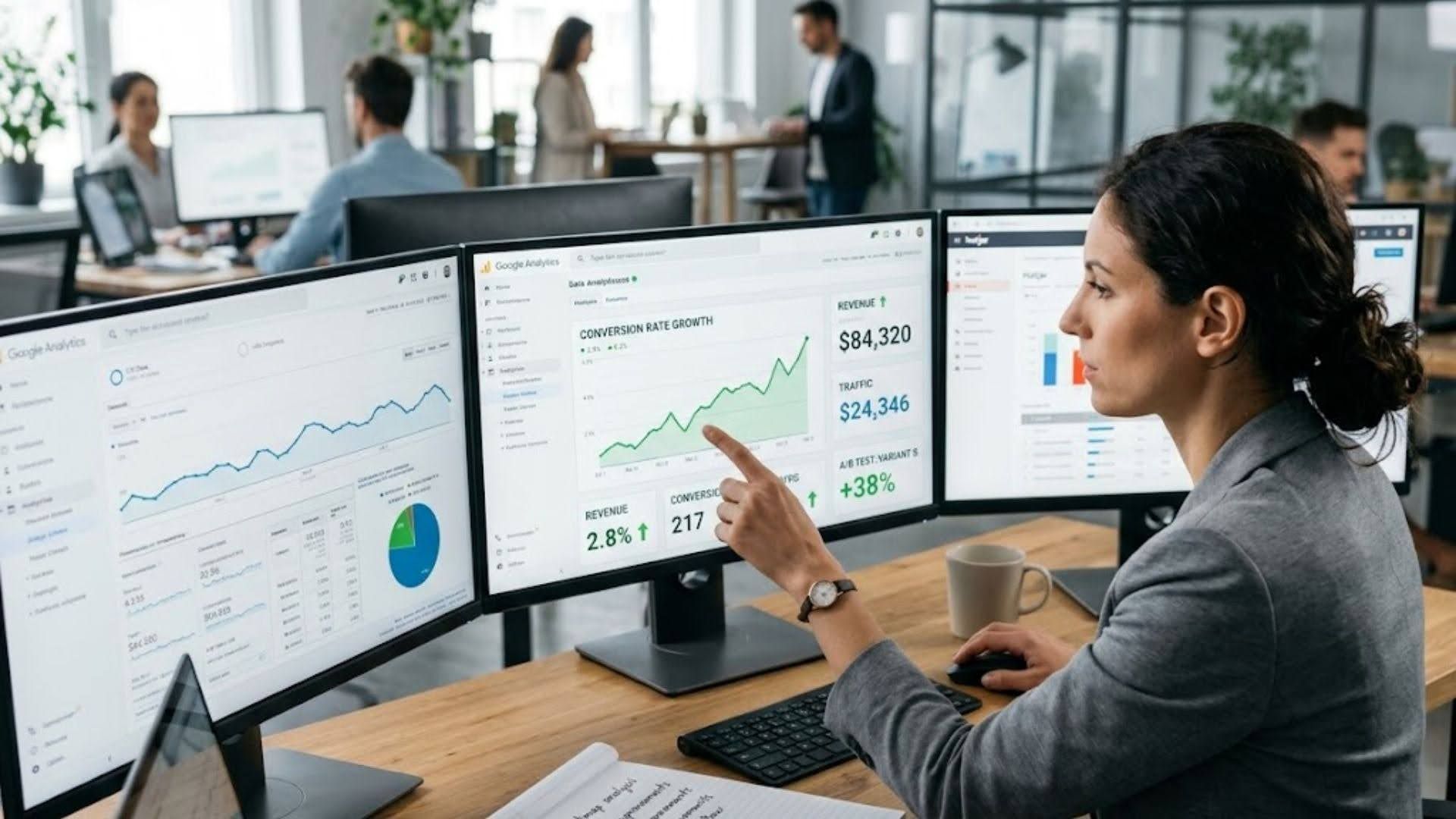
SEO consultant discusses local search performance and analytics with a business owner.
By Les Ong August 23, 2026
Avoid costly SEO mistakes. Learn how to evaluate local SEO providers and protect your business from penalties, toxic backlinks, and wasted months.
Business owner reviews local SEO performance, rankings, reviews, and website clicks on a laptop.
By Les Ong August 17, 2026
Discover when to act on local SEO. Learn the competitive signals that demand immediate action and what waiting costs your business.
Worried business owner reviews declining local SEO performance, rankings, traffic, and customer
By Les Ong August 10, 2026
Is your local SEO provider delivering results? Learn why confident promises without proven mechanics waste your budget. Get real answers.
Local business owner reviews digital marketing analytics, SEO, reviews, ads, and website growth
By Les Ong August 3, 2026
Confused about local marketing strategies? Compare Local SEO, paid ads, and DIY approaches to find the right path for your business growth.
Man Checking on his phone on UPM Digital
By Les Ong July 26, 2026
Stop losing local customers. Discover what actually boosts Google rankings in 2026 and the hidden mistakes silently killing your visibility.
UPM Digital media on Working table
By Les Ong July 20, 2026
Discover how UPM Digital Media's reputation management boosts local SEO rankings. Learn 7 proven strategies to turn reviews into ranking power.
UPM Digital media on Laptop
By Les Ong July 13, 2026
Local SEO vs alternatives for Bay Area businesses. Learn which strategy delivers faster results and builds long-term growth. Compare now.
UPM Digital Media Laptop on a mobile
By Les Ong July 6, 2026
Learn how to identify poor local SEO guidance before it damages your business. Avoid costly mistakes and protect your online visibility today.
By Les Ong June 29, 2026
According to Cisco's Visual Networking Index, video now accounts for more than 82% of all consumer internet traffic globally. For a local business in the SF Bay Area competing against regional chains and nationally optimized directories, that number isn't a trend to watch. It's a gap that's already costing you customers. Local businesses in the SF Bay Area need video marketing in 2026 because AI-powered search engines now prioritize video content when surfacing local answers, and consumers trust businesses they can see and hear before they ever walk through the door. Video builds credibility faster than any other format, directly improves local search rankings, and converts browsers into buyers at measurably higher rates than static content. Key Takeaways • AI search platforms, including Google's AI Overviews and voice assistants, pull video content into local answers, giving video-producing businesses a visibility edge over text-only competitors. • Video builds the kind of trust that closes hesitation at the moment of decision, not after it. • A single well-produced local video can serve simultaneously as a ranking asset, a reputation tool, and a conversion driver. • SF Bay Area video marketing doesn't require a Hollywood budget. Consistency and local relevance outperform production value every time. • Businesses that start building a video library now will have a compounding authority advantage over competitors who wait until video becomes unavoidable. Why Is AI Search Rewriting the Rules for Local Businesses? The shift is structural, not cosmetic. Google's AI Overviews. The AI-generated summaries now appear above traditional search results. Don't just pull from web pages. They synthesize from multiple content formats, and video content with strong metadata, transcripts, and local signals feeds directly into those summaries. The businesses AI cites are the businesses AI trusts. And AI trusts what it can read, watch, and verify. Answer Engine Optimization (AEO) is the practice of structuring content so that AI systems can extract and cite it in direct answers. For local businesses in the Bay Area, this means video content with spoken local keywords, embedded transcripts, and clear geographic signals becomes a direct input into the answers San Jose residents receive when they ask their phones "who's the best HVAC company near me?" or "which dentist in Oakland has good reviews?" Text-only businesses are invisible in that exchange. Video-producing businesses are the answer. The follow-up most business owners ask next is: "Does this mean I need to be on YouTube?" Not exclusively. Google Business Profile now supports video posts. Short-form video on platforms like Instagram Reels and TikTok is indexed by Google. Even a 60-second walkthrough of your office, embedded on your website with a proper transcript, sends a local relevance signal that static pages simply can't replicate. What Does Video Actually Do for Trust and Conversions? Here's the contrarian claim, stated plainly: most local businesses are losing customers not because they lack awareness, but because they fail the trust test at the moment of decision. A potential patient searching for a Bay Area physical therapist finds three options. Two have text bios and stock photos. One has a 90-second video of the practitioner explaining their approach in their actual clinic. The decision isn't close. And it has nothing to do with SEO rankings. The video resolves the unspoken objection before the phone call ever happens. This is the causal mechanism behind video's conversion advantage: video answers the question the buyer hasn't typed yet. It eliminates the "but what are they actually like?" hesitation that static content can't address. Practitioners using this approach consistently report that consumers who watch a service video are significantly more likely to convert than those who only read about it. A home services company in the North Bay that added a two-minute "meet the owner" video to their Google Business Profile and website landing page reported a 34% increase in quote requests within 90 days. Without changing their ad spend. The video didn't bring more traffic. It converted the traffic they already had. That distinction matters. Video isn't just a reach tool. It's a conversion infrastructure investment. How Does SF Bay Area Video Content Improve Local SEO? Local SEO is the practice of optimizing a business's digital presence to appear in geographically relevant searches. Video accelerates local SEO results through three specific mechanisms. First, dwell time. When a visitor watches a video on your website, they stay longer. Google's ranking systems interpret extended dwell time as a signal of content relevance. Which improves organic position over time. Second, backlink magnetism. Original local video content. A tour of your San Francisco location, a behind-the-scenes look at your process, a community-focused story from the East Bay. Earns organic links from local blogs, news sites, and community pages in a way that generic service pages don't. Third, and most directly tied to AEO: video transcripts. A properly transcribed video embeds spoken local keywords - "San Francisco," "Oakland," "San Jose," neighborhood references, local landmarks. Into crawlable text that search engines index alongside the video itself. This is a dual-format signal that text-only pages simply can't produce. The businesses that dominate local search in 2026 won't be the ones who posted the most content. They'll be the ones whose content AI can read, cite, and trust. UPM Digital Media's approach to Bay Area video strategy integrates all three of these mechanisms from the start, not as an afterthought once the video is filmed. What Does a Successful Local Video Strategy Actually Look Like? Two operational scenarios illustrate this clearly. Scenario 1. Healthcare practice, South Bay. A dental practice in San Jose added four short videos to their website and Google Business Profile over three months: a practice tour, a patient FAQ, a procedure explainer, and a "meet the team" piece. Each video ran under two minutes, was filmed on a professional camera, and was transcribed. Within six months, their Google Business Profile views climbed substantially, and new patient calls attributed to organic search rose without any increase in paid advertising. Scenario 2. Local restaurant, North Bay. A Marin County restaurant owner filmed a weekly 45-second "dish of the week" video using a smartphone with basic lighting. Posted consistently to Instagram Reels and Google Business Profile, the videos generated a measurable uptick in Friday and Saturday reservation requests within 60 days. The production cost was near zero. The consistency was the asset. The second scenario challenges a common assumption in this category: you don't need a large production budget to benefit from video marketing. What you need is a strategy, a publishing cadence, and content that speaks directly to your local audience. Production quality matters less than relevance and consistency. UPM Digital Media works with businesses at both ends of the production spectrum. From smartphone-first content strategies to full Bay Area video production campaigns. Because the right approach depends on the business, not a default template. Acting Now vs. Waiting: What's the Real Cost? The question isn't whether video matters. It's what happens to your business depending on the choice you make right now.
By Les Ong June 23, 2026
According to Wyzowl's annual State of Video Marketing report, more than 90% of marketers say video has directly helped increase user understanding of their product or service. And that figure has held steady for years. For a local business competing against bigger brands with bigger budgets, that is not a number to watch from the sidelines. It is a gap that is already costing you customers. The most effective video content for small business growth includes customer testimonials, behind-the-scenes footage, educational and FAQ videos, and short-form social media clips. Each format serves a distinct role in the buying journey. Testimonials resolve purchase hesitation, behind-the-scenes content builds brand trust quickly, and educational videos attract compounding organic search traffic. Together, they form a complete small business video marketing system. Key Takeaways • Testimonial videos resolve the hesitation a buyer hasn't voiced yet. That's why they outperform almost every other format at the decision stage • Behind-the-scenes content shortens the trust timeline with new audiences faster than any paid ad • Educational and FAQ videos are the only format that compounds in value over time through organic search • Platform-specific formatting isn't optional. A video repurposed without adjustment will underperform everywhere it's posted • Conversion-focused video and brand video are distinct disciplines; confusing them is the most common and most expensive mistake local businesses make Why Do Most Small Business Videos Get Ignored? Most small business video content fails before anyone even watches it. Not because of poor production quality. Because it was made without a clear job to do. A video that tries to be a brand piece, a testimonial, and a how-to tutorial all at once ends up being none of them. Viewers don't know what to do next. The business owner wonders why the phone didn't ring. The real problem isn't a lack of video. It's a lack of video strategy. Local businesses tend to produce content reactively: a quick clip here, a customer quote there, a tour of the shop when someone suggests it. What they end up with is a scattered library of footage that doesn't move a single prospect closer to a decision. This is where small business video marketing breaks down at the root level. Not in execution. In architecture. What's Actually Keeping Local Businesses From Using Video Effectively? The root cause isn't budget or equipment. It's category confusion. Most business owners treat all video as interchangeable. Same format, same length, same call to action, posted everywhere. That approach ignores a fundamental truth: different video types operate at different stages of the buying journey, and mixing them without intention produces content that fits no stage well. A behind-the-scenes clip posted to a cold audience is wasted. A brand overview video served to someone already ready to book is friction. The mechanism matters. And most local businesses have never been shown the mechanism. The VFJA Framework: Matching Video Format to Job Assignment The VFJA Framework (Video Format to Job Assignment) is a practical decision tool for matching each video type to the specific conversion objective it's designed to accomplish. Before a single frame is filmed, every video should have a named job.
Show More